Showing posts with label Research. Show all posts

Friday, May 22, 2020

Virtually Maker Faire 2020 Tonight!

We are making Personal Protective Equipment at Home... and our Make story is one of hundreds being shared, virtually around the world. As of last night, with San Diego 3D Printing For a Cause, we have made, and donated 10,336 pieces of PPE, including ear-savers, face shields, and fabric masks, since April 1!


Learn our Make story, and many others at Virtually Maker Faire!

Around the world makers have been rallying, rising up to solve shortages in medical supplies and equipment, turning makerspaces into micro-factories, creating self-organized community networks, and developing clever distribution strategies. For our inaugural Virtually Maker Faire, makers representing 25 countries will share over 350 presentations, demonstrations, and online project exhibits. Programming is curated into five tracks: Community Organizing, Learning & Teaching, Re-Thinking the Future, Design & Production, and Making.

Virtually Maker Faire is a stage for makers to connect, share, and learn with each other and a broader public, and show how the community fostered by Maker Faire has sprung into action, using their skills and talents to solve for human needs.

Plan out your virtual day with the full schedule or meet some of our fantastic makers.

Upcoming Session Highlights
Check session pages or the schedule for updated times.
Making a Global Movement in Crisis: the Story of Open Source Medical Supplies
Gui Cavalcanti, founder of Open Source Medical Supplies, will talk about the role of Open Source in the pandemic and how their group documented the global fabrication of over 7 million units of personal protective equipment, medical and community supplies.
View Session

How Making 3D Printers Widely Available Enabled Covid-19 Solutions: From RepRap to Prusa
Maker Faire Founder Dale Dougherty will talk with RepRap's Adrian Bowyer and Josef Prusa of Prusa Research about the rise of 3D printing and how getting 3D printing in the hands of more people enabled so many of the PPE solutions from the maker community, including developing and testing the Prusa Face Shield and its spread around the world.
View Session

DIY Heroes: Meet the Makers Featured in Make: Vol. 73
The new issue of Make: magazine looks at the maker response to the COVID-19 pandemic. Join Make:’s Executive Editor Mike Senese and the editorial team as they discuss the new issue with the various subjects that are profiled in its pages.
View Session

Pivoting in the Pandemic — Adafruit NYC
Adafruit founder Limor Fried will talk about pivoting production smartly and safely during the pandemic, from making face shields to essential electronic components as their home town of New York City became a hot spot for the virus.
View Session

How to Use Social Media as a Maker Portfolio
Panelists Ana Karen Ramirez, Estefannie Explains It All, Jen Schachter, and Xyla Foxlin will discuss how to leverage social media to showcase your work, create your own maker community, and give a glimpse of the behind the scenes of your processes.
View Session

ArcAttack's Tesla Coil Music
Tesla coil music live-streamed from ArcAttack’s shop as a Grand Finale to Virtually Maker Faire!
View Session

Wednesday, May 20, 2020

Making Personal Protective Equipment & Plan C

Together with San Diego 3D Print For a Cause, we have been developing, manufacturing, and distributing Personal Protective Equipment to healthcare facilities, since late March. As of May 13, in 42 days, with 28 dedicated volunteers, here is what we have achieved...

Delivered 8,616 PPE articles, including 3,261 face shields.
100+ hospitals and clinics have received PPE, including facilities in California, Arizona, Colorado, Georgia, and the Navajo Nation.
Thanks to additional volunteers, 425 sewn masks were made and donated. And! These masks can be ordered at SD Print 4 Cause.


Maker Faire, with Make Magazine, is hosting a global, virtual Maker Faire, on May 23! We love making and sharing, and we are eager to see as many of the entries as possible, in 24 hours! We are particularly interested in Make Magazine's highlight: Plan C From Maker Space: "Comprehensive coverage of the community response to the Covid-19 crisis." And we are going to share our own process and efforts in casting PPE, which includes research, setbacks, prototyping, learning, tinkering, and successes... the usual Make journey, with higher stakes.

Making PPE, at home, while doing all of our usual jobs, like programming, schooling, gardening, chicken wrangling, goat herding, cat grooming, cooking, cleaning... It's a lot! We would like to document all of our work, with tutorials, and we need to create some kind of exhibit-virtual presentation for Maker Faire (yikes). In the meantime, if you'd like an idea of what we have been doing, please look for us at Instagram, @boomNerds, and follow our volunteer friends, where we post on FaceBook as "San Diego 3D Printing for a Cause & Friends."

Please! Our work is urgent and meant to save lives...
if you can, Follow, Like, Share, Donate,
we would be so thankful!
Support helps and we appreciate all of it!
Thank you.


Thursday, February 25, 2016

Make Stamps


Playing! Experimenting. Messing up. Trying again. Learning...

I am collecting supplies for stamp making, and print making. It can be as simple as having a sheet of rubber, carving tools, and an ink pad. This time, to make the pig, I traced a sticker of a pig, drawing with a pencil. Then I used my Speedball cutting tool (sold for linoleum carving) and slowly, peeled away the outline of the pig and details. The tool is too big for the tiny piece and details I want to carve, so the effect is what I like to call "rustic." Let's be clear: I am not ready to post tutorials, but I am excited to share the beginning of my journey.

The other thing I tried is making a bigger image to print from the lid of a Styrofoam food container. Humbling! I learned this method when I was an art volunteer in Maria's fifth grade class; the students made and printed portraits of themselves. Now that I've tried carving Styrofoam, (pressing firmly into the soft foam with a pencil, or blunt tool) I can see it's not as easy as it looks. It definitely seems to be something that will work better with large images, and few details. Also, I didn't roll ink on my stamp with a brayer, but just dragged it across the surface of the stamp pad. Anyway, I love the children's art, find it very inspiring, and now that I've tried it for myself I am ten times more impressed with what they made! I may be asking them for tips.


Maria and her classmates are really sweet, fun to work with. And they enjoyed this project so much, it seemed to me it could be a fun activity to bring to Maker Faire. Maybe with smaller stamps? I'm still figuring it out, playing. It's fun. Messy, too. If not Bay Area, then something for one of our mini events, here at the Bird House. There are great ideas and suggestions to be found at Pinterest. I searched "scratch foam printing" and found plenty to get things going!

**Important Update**
So, it turns out food container lids are not the same as the crafting foam the students used when they made their portraits. Happily, the stuff I ordered from Blick will be easier to use, so I am very excited to be getting the good stuff. I had my suspicions, because the styrofoam I used to make the bird was behaving very poorly... no smooth lines, only deep and crumbly, jagged cuts. But thanks to Vicki at Art With Kids, I have been reassured that Scratch-Foam printing boards will be much easier to work with.

If we do share this activity in a Maker event, it's essential to have the right tools, and nice quality materials, because when learning how to make things, it's such a bonus for things to go well. Very often in arts and crafts, especially with children, the cheapest supplies come out... of course this cannot always be helped, but whenever possible I think it's important to use the best available supplies, for greater success, and nicer finished products.

Saturday, November 14, 2015

Fullmetal Alchemist

Hello, BOoM is looking for anyone who has a recipe for any or all of the following alloys:

1. Britannia Metal
2. English Pewter
3. Field's Metal
4. Any other non-toxic fusible alloys.

And by "recipe" I mean a description of the process for making the alloy (temperatures, times, etc.) The proportions are readily available on the Interwebs, but detailed descriptions of the processes are surprisingly hard to find.

An alloying anecdote:

I was searching for recipes and kept coming across the term "Regulus of Antimony" in old mettallurgy books. Well I know what Antimony is, but had no idea what a Regulus of Antimony is. So I Googled it, of course, and found some fascinating history...

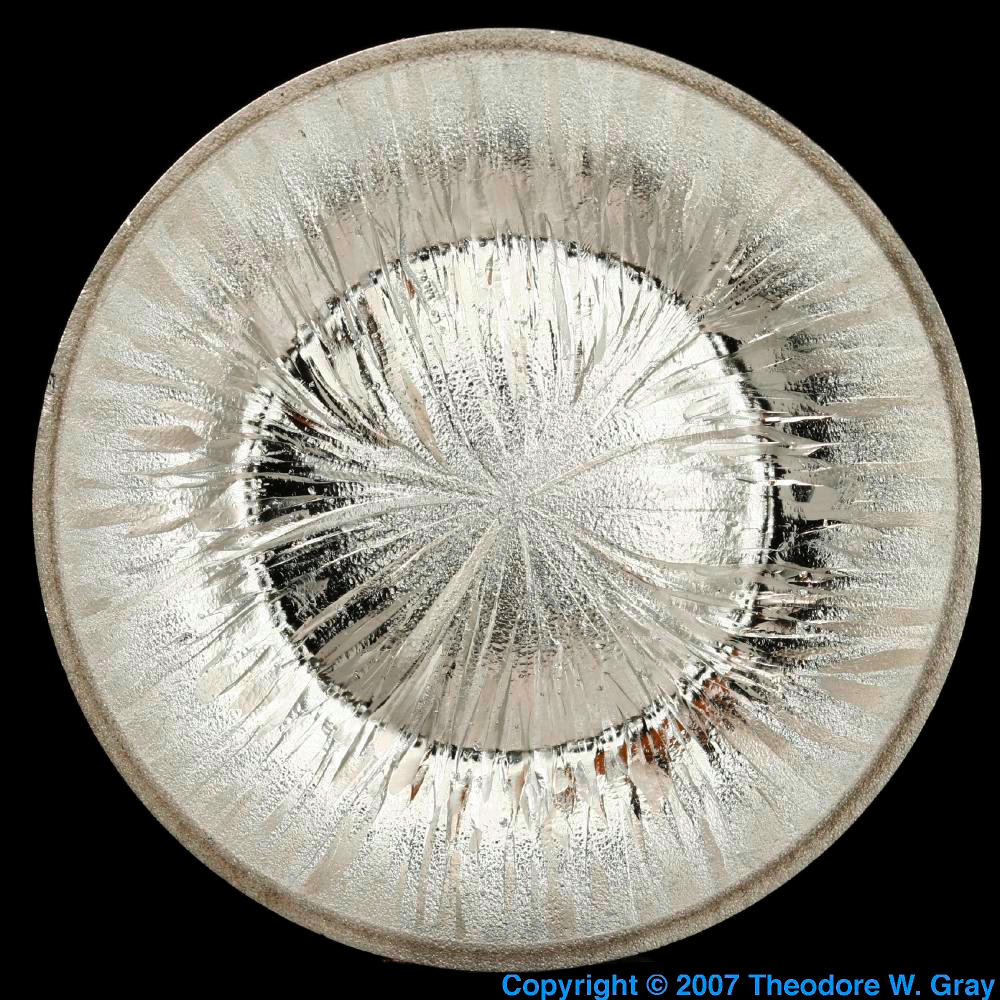
"Regulus of Antimony" is actually a term from alchemy that carried over into modern metallurgy. "Regulus" refers to the star Regulus in the constellation Leo. Under certain conditions, when molten, slightly impure, Antimony metal cools slowly, it forms a star shaped crystalline pattern on the surface of the metal.


And guess who was the Fullmetal Alchemist of his age and was trying to use Regulus of Antimony to produce the philosopher's stone... Isaac Newton. That's right: Isaac Frickin' Newton, target of falling apples, inventor of the Calculus, and all-around genius.

Further refinements would create crystalline "rays" on the surface of the metallic antimony, hence it was called the star-regulus of antimony. Starkey then fused the star-regulus with silver or copper, which allowed him to amalgamate the antimony with quicksilver. Eventually, he produced a "sophic mercury" in which gold could be made to dissolve and "vegetate"—forming tree-like growths. Starkey, and Newton, believed this "vegetation" was evidence that sophic mercury was a key to producing the ultimate agent of transmutation—the philosophers' stone.

From "Newton's Alchemy," by Bill Newman